
SDG 5: Gender Equality
Phoenicia University (PU) is committed to advancing SDG 5 by actively promoting gender equality and women’s empowerment across all levels of higher education, institutional leadership, and community engagement. Through equitable access policies, targeted support and mentorship programs, non-discrimination frameworks, and community outreach, PU works to ensure equal opportunities for female students and staff, promote women’s leadership in academic and professional spheres, and advocate for gender equity in South Lebanon.This commitment reflects the University’s core mission of cultivating an inclusive, diverse, and safe environment where all individuals can succeed and lead without systemic and cultural barriers.
5.2 Proportion of women first-generation
The table below presents data on total enrollment, newly admitted degree students, and first-generation representation—specifically tracking incoming first-generation female students—at Phoenicia University for the 2023–2024 academic year.
| First-generation female | Number |
|---|---|
| Number of students | 1262 |
| Number of students starting a degree | 378 |
| Number of first-generation students starting a degree | 294 |
| Number of women starting a degree | 216 |
| Number of first-generation women starting a degree | 168 |
5.3.1 Tracking access measures
Phoenicia University (PU) systematically measures and tracks access to higher education through comprehensive, gender-disaggregated data collection across all admission pathways. To ensure systemic equity, transparency, and inclusive access, the University utilizes advanced enterprise software, PowerCampus, to monitor and audit student metrics in real time.
Through this system, the Admissions Office captures every phase of the student lifecycle, including:
- Application & Demographics: Full applicant profiles, including tracking gender metrics.
- Academic Intent: Program and college choices across all disciplines.
- Admission Status: Real-time tracking of acceptance, rejection, and waitlist status.
Data Disaggregation and Measurable Outcomes
With PowerCampus fully integrated into university operations, the Admissions Office can immediately disaggregate data by gender, program, and specific college. Recent institutional data demonstrates that these targeted equity measures are achieving measurable success across key admissions milestones:
- Acceptance Rates: Among applicants to PU, 74% of female applicants were accepted, compared with 67% of male applicants.
- Yield Rates: Following acceptance, 63% of admitted female students successfully enrolled in the University, compared to 57% of admitted male students.
This evidence-based approach allows PU to identify potential demographic gaps, refine targeted outreach strategies, and actively uphold its institutional commitment to gender parity and equal opportunity.
Commitment to Continuous Evaluation
These access and equity indicators are reviewed annually by the Quality Assurance and Accreditation (QAA) Office as part of its institutional review cycle, in coordination with the Admissions Office and the Office of the Registrar. Gender-disaggregated data from PowerCampus is assessed against equity benchmarks across each college and admission pathway, with findings reported to the top University management.
Where gaps are identified, findings feed directly into PU's admissions and outreach strategy — for example, the targeted recruitment measures for underrepresented disciplines described in Indicator 5.3.4. This closes the loop between data collection, institutional accountability, and the University’s operational commitments under SDG 5: Gender Equality.
Table 1. Admissions by Gender (2023–2024)
| Measure | Female | Male | Total |
|---|---|---|---|
| Applicants | 464 | 420 | 884 |
| Accepted | 342 | 283 | 625 |
| Enrolled | 216 | 162 | 378 |
| Acceptance Rate (Accepted/Applicants) | 74% | 67% | 71% |
| Yield Rate (Enrolled/Accepted) | 63% | 57% | 60% |
Table 2. Enrollment by Gender (2023–2024)
| College | Female | Male | Total |
|---|---|---|---|
| College of Architecture & Design | 48 | 9 | 57 |
| College of Arts and Science | 43 | 51 | 94 |
| College of Business | 35 | 31 | 66 |
| College of Engineering | 33 | 68 | 101 |
| College of Law & Political Sciences | 20 | 2 | 22 |
| College of Public Health | 37 | 1 | 38 |
| Grand Total | 216 | 162 | 378 |
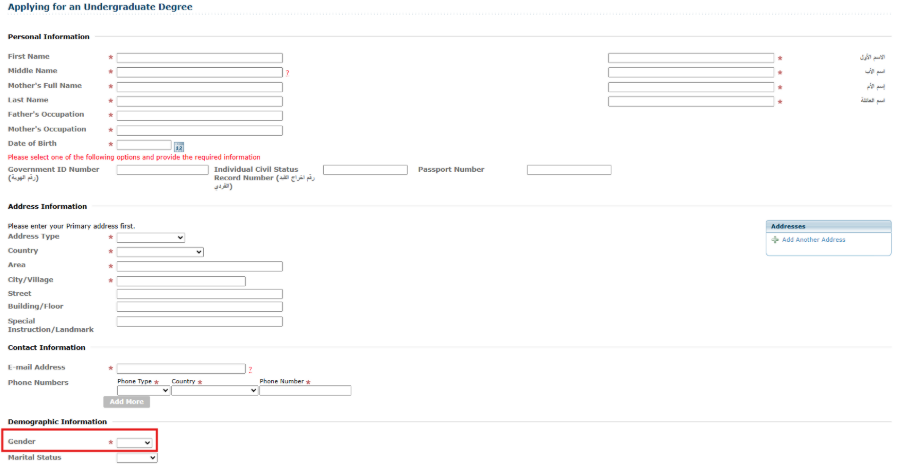
Figure 1. Excerpt from PU’s undergraduate admission application capturing applicant demographic data, including gender.
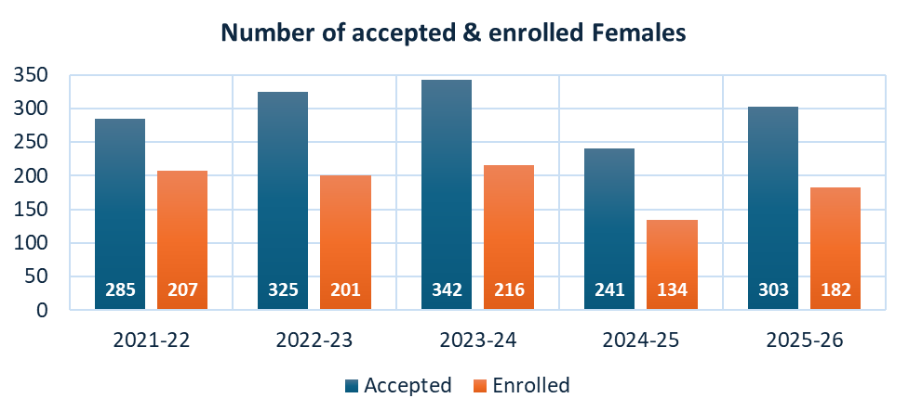
Figure 2. Female Acceptance & Enrollment (2021–2026)
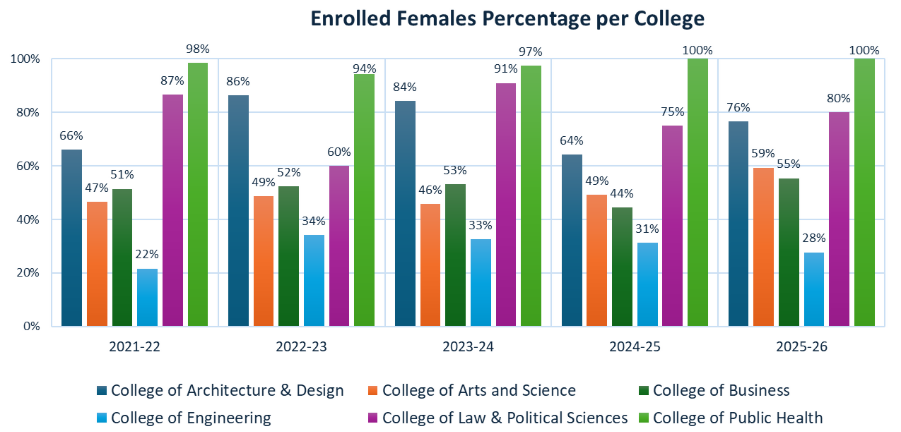
Figure 3. Female Enrollment (%) by College (2021–2026)
5.3.2 Policy for women applications and entry
Phoenicia University's admissions framework is governed by two instruments: the Admissions Office Policy, which sets merit-based, non-discriminatory selection criteria aligned with Lebanese Ministry of Education and Higher Education regulations, and the Women's Access and Participation Policy, which sets out targeted commitments to women's access, recruitment, and progression across the student lifecycle.
Under the Admissions Office Policy's Equality and Diversity section, PU commits to equal opportunity regardless of age, gender, marital status, race, ethnicity, or nationality and explicitly links financial aid access to the Women's Access and Participation Policy, ensuring aid is available through fair and transparent processes to reduce financial barriers to women's enrollment.
The Women's Access and Participation Policy sets out provisions specific to the admissions pipeline. Its Outreach and School Engagement section commits PU to school visits, career guidance, and mentoring activities that introduce female students to higher education and encourage entry into historically underrepresented disciplines.Its Support for Women in Non-Traditional Fields section names Computer Science and Engineering specifically, committing PU to outreach, mentoring, and targeted scholarships to support women's participation and retention in STEM.Its Recruitment, Admissions, and Applicant Support section commits PU to equitable access to information and guidance for prospective female applicants throughout the admissions process.
Progress against these commitments is intended to be tracked under the Policy's Systematic Monitoring and Assessment section, which calls for regular review of gender-disaggregated data on access, participation, progression, and academic achievement — consistent with the PowerCampus-based tracking described under Indicator 5.3.1.
PU admits qualified students to all freshman, undergraduate, and postgraduate programs regardless of gender, race, religion, nationality, or disability, with support services in place for students with disabilities. Applications are accepted on a rolling basis across Fall, Spring, and Summer intakes per the official Academic Calendar.
Admission Requirements | Phoenicia University
Freshman | Phoenicia University
Freshman Tuition and Fees | Phoenicia University
Undergraduate | Phoenicia University
Undergraduate Tuition and Fees | Phoenicia University
Graduate – Master of Business Administration (MBA)
5.3.3 Women's Access Schemes
Phoenicia University pairs universal student support infrastructure with a smaller set of schemes designed specifically to remove barriers facing women, most notably in financial aid, STEM participation, and leadership development. This section documents both the targeted schemes and the broader support ecosystem that all students, including women, can draw on.
Female Financial Aid for STEM Disciplines
Under PU's Financial Aid and Scholarship framework, a dedicated scholarship category — Female Financial Aid for STEM Disciplines — is reserved for female applicants admitted to Computer Science or Engineering programs, based on admission eligibility, academic performance, and financial need. In the 2023–2024 academic year, this category accounted for 100% of its recipients, directly supporting entry into two of PU's historically male-dominated colleges.
Women Empowerment Club
Supported directly by senior leadership and active on campus, the Women Empowerment Club has run programming promoting gender equality and women's leadership since 2020 Student Clubs & Societies. Its flagship initiative, the Women Empowerment Market, gave 11 female-led student and community ventures a free, on-campus platform to gain market access and sales experience. The Club also co-organizes recurring events with the regional gender-equality NGO ABAAD, including a campus seminar on combating sexual harassment and a psychological empowerment and self-image workshop.Seminar on Combating Sexual Harassment | Woman Self-Image Workshop
Female-to-Female Mentoring
PU operates a University-wide Student Mentorship Program, a collaboration between the Student Affairs Office, the University Diversity Officer, and the Minorities Center. The program pairs first-year students with trained peer or alumnae mentors to support their academic transition, engagement, personal development, and successful integration into university life. The programme provides guidance on academic expectations, campus resources, study skills, and student life while fostering a supportive learning community.
Building on this institutional programme, PU operates a female-to-female mentoring scheme within STEM disciplines that demonstrate comparatively higher female student attrition. The scheme pairs incoming first-year female students with senior female peer mentors at a 1:4 mentor-to-mentee ratio , providing peer support, practical advice, and experience-based guidance to support women's retention, engagement, and successful progression through their studies.In the 2023–2024 academic year, the scheme achieved 100% participation among incoming female cohorts, supporting all 23 newly admitted female students in Computer Science and all 33 newly admitted female students across Engineering majors. Mentors serve as relatable role models who have successfully navigated the same academic path, helping mentees address personal and professional challenges while strengthening their confidence and sense of belonging within their chosen field.
Career Centre Initiatives
Pioneer Placements
Securing top-quality internship opportunities for women in male-dominated fields
PU's Career Center works closely with employer partners to secure internship opportunities for female students in fields where women are historically underrepresented, particularly Engineering and other technical disciplines — ensuring access to placements of the same caliber and technical scope as those available to male peers. As part of this process, the Career Center coordinates directly with partner organizations on workplace logistics and accommodations, supporting a smooth and fully participatory experience for students entering site-based or technical roles.
In the 2023–2024 academic year, placements secured through this scheme included:
- Nour Al Hoda J. Arnaout, Electrical and Communication Engineering, interned at JA Square, a telecommunications and IT solutions firm headquartered in Lille, France, with 16 branches worldwide.
- Jana Moussa and Nour Wafic Dagher, Electrical and Communication Engineering, interned at MTC Touch Lebanon, one of Lebanon's leading mobile telecommunications and data operators.
- Fatme Mohsen Ezzeddine, Electrical and Communication Engineering, interned at Gulf Consult in Kuwait, a multidisciplinary consultancy spanning planning, architecture, and engineering design.
Through this scheme, PU aims to ensure women's exposure to professional opportunities in STEM extends beyond the classroom into the same caliber of professional environments as their male peers, supporting their progression into sectors where women remain historically underrepresented.PUCC Services
STEM Career Readiness Training
Beyond securing the placement itself, PU provides specialized career guidance and readiness training for female STEM students, preparing them with the qualifications, professional skills, and confidence needed to compete for top internship opportunities and build lasting careers in technical fields.In 2023–2024, 41 female STEM students received this specialized career guidance.PUCC Services
Learning Development Center – Peer Support Initiatives
PU's Learning Development Center (LDC) provides academic and personal support to all students through four units, Peer Support, Public Speaking, the Writing Center, and Workshops and Training. Two Peer Support initiatives are especially relevant to fields where women are historically underrepresented: the Computer Science Peer Support Program, offering academic course-related assistance and peer-led collaboration for Computer Science students, and the PU ASME Peer Support Program, supporting collaboration, inclusivity, and student well-being within Mechanical Engineering.
Computer Science at PU sits within the College of Arts and Sciences, led by Dr. Mageda Sharafeddin, one of PU's two female college deans, giving female Computer Science students a visible female leader at the head of their own college , not just a peer-level support program.
Demonstrating strong engagement in these specialized fields during the 2023–2024 academic year, 34 out of 42 female Computer Science majors actively participated in the Peer Support initiative, while 9 out of 12 female Mechanical Engineering majors engaged with the ASME Peer Support Program. By actively embedding female students into peer-led academic networks, these programs strengthen retention, foster peer collaboration, and directly advance the university's commitment to gender inclusion in technical disciplines.
Specialized Reporting Pathway for Gender-Based Harassment
PU maintains a dedicated intake pathway for complaints involving gender-based or sexual harassment, separate from the University's general discrimination complaints process as addressed in Sections 6.3 and 15.2 in both Student and Staff/Faculty Nondiscrimination Discriminatory Harassment and Retaliation Policies. Staff and Faculty Nondiscrimination Discriminatory Harassment and Retaliation Policy | Student Nondiscrimination Discriminatory Harassment and Retaliation Policy This pathway is staffed by personnel with specialized training in the confidential handling of such complaints and is overseen by the University Diversity Officer (UDO), ensuring that individuals reporting gender-based harassment are met with appropriately trained staff from first contact.
The pathway has received and resolved reports since its establishment in 2022. Staff are prepared through a train-the-trainer model: personnel who complete external specialized training go on to train colleagues internally, extending capacity across the team over time.
The University Diversity Officer has received training on gender-based violence from multiple recognized external bodies, including:
- PLAN International's Gender Based Violence – Reproductive and Sexual Health program.
- Lana Haq (We Have a Right) Initiative, Jordan — A member of Center staff served as Change Maker Officer at CFUWI, in partnership with Oxfam (2015), where she initiated the Lana Haq ("We Have a Right") Initiative: cross-country study visits on gender equality, women's empowerment, and social inclusion, engaging civil society organizations and community leaders on women's participation in education, employment, and leadership.
Minorities Center: Women's Continuity Pathway
Women's Continuity Pathway
The Minorities Center serves as a coordinated support pathway for women whose education is at risk of interruption or who have already paused their studies, regardless of the underlying reason, including childcare needs, marriage, caregiving responsibilities, financial hardship, or other personal circumstances. Rather than treating these as separate, one-off issues handled inconsistently across departments, the Center acts as a single point of coordination for any woman navigating a pause in her education or seeking to return.
Minorities Center staff receive specialized training to support readmission specifically, helping women navigate the re-enrollment process, coordinate with the relevant academic and financial aid departments, and manage the logistical steps required to resume their studies. Where childcare is a barrier to continued attendance, students are connected directly to PU's existing subsidized childcare partnership with the Lebanese Welfare Association for the Handicapped LWAH Centers| Childcare Facility where the barrier is financial, academic, or logistical, staff coordinate directly with the relevant university departments to support a defined path back to enrollment. Women's Access and Participation Policy
Scholarships
PU is committed to supporting women's access to higher education through a range of financial assistance mechanisms, including merit-based scholarships, need-based grants, work-study opportunities, and student loans.Seven of PU's eight financial aid categories are open to all students regardless of gender, with a review committee objectively selecting recipients based strictly on financial need and academic performance. Across these general categories, women represented 56.8% of recipients in the 2023–2024 academic year.PU also granted full scholarships to four female students who ranked in the top five overall in the Lebanese Baccalaureate examinations that year.Top 5 Baccalaureate Students Scholarships 2023-2024 | Phoenicia University
In addition to these general categories, PU offers a dedicated Female Financial Aid for STEM Disciplines, a supplemental, targeted award for female applicants admitted to Computer Science or Engineering programs, addressing the documented underrepresentation of women in those specific majors rather than displacing aid available to other students. Financial Aid and Scholarship Policy
Types of Financial Aid and Scholarship
PU offers eight categories of financial aid and scholarships, summarized below:
| Category | Basis of Award | Primary Eligible Population |
|---|---|---|
| Merit Scholarships | Outstanding academic achievement | Top 5 Baccalaureate scorers nationally and through equivalent international diplomas |
| Need/Merit-Based Financial Aid Grants | Financial need, with solid academic standing | Students who need support to make their education possible |
| Social Welfare Full Scholarship Support | Significant financial hardship | Students from the lowest-income households |
| Loan-Based Financial Aid | Short-term support with tuition timing | Students facing timing difficulties with fees |
| Work-Study Program | Financial need, paired with work experience | Students from lower-income households, low-income countries, and LLMICs |
| Employee and Staff Family Tuition Scholarship Benefits | Staff affiliation | PU employees' dependents, siblings of PU administrative staff, and PU staff pursuing graduate studies |
| Special Needs Scholarship | Differently-abled students | Students with disabilities or other special challenges |
| Female Financial Aid for STEM Disciplines | Promoting women's access and participation in STEM education | Female students enrolled in STEM programs who require financial support |
Summary: Percentage of Students Benefiting from Financial Aid Programs (2023–2024)
| Category | Females (%) | Males (%) |
|---|---|---|
| Need/Merit Based Financial Aid | 50% | 50% |
| Merit Scholarship | 100% | 0% |
| Social Welfare | 40% | 60% |
| Loan | 20% | 80% |
| Work Study Program | 67% | 33% |
| Employee Dependent and Staff Sibling Scholarships | 50% | 50% |
| Special Needs Scholarship | 0% | 100% |
| Female Financial Aid for STEM Disciplines | 100% | 0% |
| Total | 56.8% | 43.2% |
Other Provision
School Outreach Activities
PU conducts systematic annual outreach visits to selected schools, including both girls’ and co-educational institutions. The university reaches 8,750–10,500 prospective students across approximately 175 institutions each academic year, ensuring broad access for female and male students. In 2024, the PU targeted visits to 16 girls' schools, directly engaging around 900 female students, complemented by outreach to 159 co-educational institutions, reaching a total of approximately 5,500 female students across both learning settings.
These outreach visits include structured presentations on academic programs, admission pathways, and career opportunities, with a specific focus on encouraging female students to pursue Engineering and Computer Science disciplines. These outreach visits are designed to increase awareness of STEM pathways among female students and encourage interest in these disciplines School Visits and Outreach | Phoenicia University
Female Role Models in Outreach Activities
A key element of the outreach strategy is the inclusion of female role models to enhance engagement and relatability, including:
- Female Student Ambassadors: Enrolled in STEM programs (Engineering, Computer Science), who share personal academic trajectories, research experiences, and career pathways.
- Female Faculty & Coordinators: Academic staff from relevant technical departments who lead interactive discussions.
- Admissions Collaborations: Joint sessions delivered to support informed academic decision-making regarding prerequisites and pathways.
These interactions function as informal mentoring touchpoints, supporting confidence-building and assist in informed subject selection among prospective female students.
Academic Enrichment and STEM Visibility
In addition to school visits, PU organizes structured engagement activities and digital visibility initiatives designed to make female scientific achievements highly accessible:
- On-Campus Visits & Lab Demonstrations: Hands-on laboratory tours where prospective female students interact directly with women faculty, researchers, and current STEM students.
- Digital Research Spotlights & Web Features: The University maintain a dedicated, publicly accessible digital media strategy that systematically publishes website posts and articles highlighting groundbreaking research led by female faculty and researchers.
PU featured the latest research by Dr. Diana Hadi, advancing both academic enrichment and STEM-driven educational innovation through her evaluation of technological solutions for neurodivergent learners. Her published paper dives into the emotional, social, and academic impacts of dyslexia, mapping how emerging educational technologies—such as text-to-speech software, dyslexia-friendly typefaces, and personalized learning platforms—can build accessible learning environments. This research underscores PU's dedication to using technical innovation to solve real-world educational barriers. New Research by Dr. Diana Hadi on Dyslexia and Technological Interventions | Phoenicia University
Additionally, PU highlighted sustainable engineering research co-authored by Dr. Mariam Itani and senior student Khadija Ramadan, presented at the 2024 ASHRAE Conference. By developing CAHEP-PCM composite materials to improve building envelope efficiency, their work elevates STEM visibility through collaborative female mentorship and drives academic enrichment in green building design. Innovative Energy-Efficient Building Research at ASHRAE 2024 | Phoenicia University
These research stories are integrated into outreach toolkits and shared with targeted schools, providing prospective students with tangible, real-world examples of successful women driving innovation at the institutional level.
5.3.4 Women’s Applications in Underrepresented Subjects
Through University Outreach
PU implements a structured institutional approach to increase female applications and participation in disciplines where women have been historically underrepresented, particularly Engineering and Computer Science fields. This approach integrates targeted outreach, STEM visibility strategy, and academic engagement activities within the admissions and recruitment process.
Integrated Recruitment and Outreach Approach
To bridge the gender gap in fields where women are historically underrepresented, we proactively drive female recruitment and engagement through the following initiatives:
- Targeted Messaging: Delivered during school outreach visits, international freshman programs, and campus summer camps, explicitly highlighting financial aid, scholarships, opportunities, and career paths available to female students in STEM. As outlined in PU's Financial Aid and Scholarship Policy, PU offers a dedicated Female Financial Aid for STEM Disciplines, a supplemental, targeted award for female applicants admitted to Computer Science or Engineering programs, encouraging gender equality more broadly in STEM fields.
- Dedicated STEM Information Sessions: Hosted during high school visits, school fairs, and University Open Days, showcasing technical disciplines and removing perceptual barriers for prospective female applicants.
- Marketing Representation: Tracked under PU's Representation in Marketing and Communications KPI, ensuring promotional materials, websites, and media campaigns actively feature and normalize female participation in technical higher education.
This integrated approach is governed under the University’s central strategy framework (Strategic Priority 2 in Goal 4 – Diversity, Equity and Inclusion) which is supported by Phoenicia University’s Goals and Strategies.Goals and Strategies
STEM Visibility Strategy
PU promotes the visibility of women in STEM disciplines through the recognition of student and faculty achievements in institutional communication channels, tracked under PU's Representation in Marketing and Communications KPI and governed under the university's central strategy framework (Strategic Priority 2, Goal 4 – Diversity, Equity and Inclusion, Goals and Strategies. These achievements are featured through PU's outreach and promotional materials, ensuring prospective female applicants encounter tangible, relatable role models — not just abstract encouragement — when considering Engineering and Computer Science programs.
PU has expanded female students' access to role models in traditionally male-dominated technical fields, including through Diana Kaissy, Executive Director of the Lebanese Oil and Gas Initiative (LOGI) and a recognized advocate for transparency and governance in Lebanon's energy sector, who has been serving as a Lecturer in the Engineering Program at PU since 2024, giving Engineering students , particularly women in a field where they remain significantly underrepresented — ongoing engagement with a leading female figure in Lebanon's energy sector. Ms. Kaissy also delivered a guest session at PU,Session on “Lebanon's Oil and Gas Well: Past, Present, and Future" in January 16,2024.
Additionally, Electrical and Computer Engineering (ECE) student Nour Dagher participated in an international training program in Egypt, showcasing technical skills development and international exposure. Computer Science student Marwa Zeineddine secured first place at the “Arab Championship for Scientific Talents” competition in Baghdad, organized by the Scientific Care Department of the Iraqi Ministry of Youth and Sports, competing against top young innovators from across the Arab world.
On December 18, 2023, the Department of Student Affairs and the IEEE Student Branch hosted Dr. Nadine Abbas, Assistant Professor in Computer Science and Mathematics at the Lebanese American University (LAU), as keynote speaker for the campus seminar "Towards the Next-Generation Communication Systems". The seminar gave engineering and computer science students — particularly female IEEE members — direct access to a high-achieving female role model in next-generation networks research.
Through these combined activities, governed by PU's published institutional strategy and tracked under its Marketing and Communications KPI, the University systematically enhances the visibility of women in higher education and provides prospective and current female students with tangible role models in the fields where they remain most underrepresented.
5.4 Proportion of Senior Female Academics
PU demonstrates outstanding progress toward gender equality in academic leadership, recording a 50% female representation in senior academic positions (27.0 FTE out of 54.0 FTE). This milestone directly reflects the university's commitment to UN Sustainable Development Goal 5 by dismantling institutional barriers and ensuring equitable career advancement into senior faculty, professorial, and decision-making roles. Furthermore, with senior positions accounting for 77.1% of total academic capacity (54.0 FTE out of 70.0 FTE), senior female academics represent 38.6% of the overall academic workforce, establishing a sustainable leadership pipeline and strong mentorship environment for future generations of women in academia.
| Proportion of women in senior positions | Number |
|---|---|
| Number of academic staff | 70 |
| Number of senior academic staff | 54 |
| Number of female senior academic staff | 27 |
5.5 Proportion of Female Degrees Awarded
| Number of Female Graduates | Number |
|---|---|
| Number of graduates: Total | 358 |
| Number of graduates by subject area (STEM, Medicine, Arts & Humanities / Social Sciences): Total | 150 |
| Number of graduates: STEM | 81 |
| Number of graduates: Medicine | 31 |
| Number of graduates: Arts & Humanities / Social Sciences | 38 |
| Number of female graduates by subject area (STEM, Medicine, Arts & Humanities / Social Sciences): Total | 81 |
| Number of female graduates: STEM | 25 |
| Number of female graduates: Medicine | 30 |
| Number of female graduates: Arts & Humanities / Social Sciences | 26 |
In the 2023–2024 academic year, PU awarded degrees to a total of 150 graduates distributed by subject area, of whom 81 were women—yielding an institution-wide female graduation rate of 54.0%. This exceeds the global tertiary education norm: UNESCO reports women now outnumber men in global tertiary enrollment (113 women per 100 men, roughly 53%), meaning PU's female graduation rate is consistent with global enrollment patterns.
Female graduates held the majority in five of PU's six colleges: College of Public Health (96.8%), Law & Political Sciences (71.4%), Arts and Science (57.9%), Business (52.4%), and Architecture & Design (45.5%). In each, the female graduation share closely tracks the female enrollment share, indicating women who enroll complete their degrees at the expected rate rather than leaving disproportionately.
The data indicate that the gender gap in Engineering is primarily an access and recruitment challenge rather than a retention issue. Women account for approximately 28% of Engineering graduates, broadly consistent with their 22–34% share of Engineering enrolment over the corresponding academic years. This directly informs PU's approach under Indicators 5.3.3 and 5.3.4, prioritizing pre-application outreach over in-program retention interventions, since retention isn't where the gap originates.
5.6.1 Policy of non-discrimination against women
Phoenicia University (PU) enforces a comprehensive non-discrimination framework encompassing dedicated Student Nondiscrimination, Discriminatory Harassment and Retaliation Policy, Staff and Faculty Nondiscrimination, Discriminatory Harassment and Retaliation Policy, Grievance Policy and Procedure, Discrimination and Harassment Policy, and Equal Employment Opportunities Policy.These policies strictly prohibit discrimination, harassment, sexual misconduct, and retaliation against women across all institutional spheres. The framework guarantees equal opportunity and non-discrimination for women throughout every stage of the employment lifecycle, including recruitment, selection, working conditions, compensation, professional development, promotion, and termination.Furthermore, it ensures an inclusive, safe, and equitable learning and working environment for female students, faculty, and staff by pairing proactive educational initiatives with prompt, fair grievance resolution procedures to uphold dignity, gender equity, and equal access across the entire university community. By creating an inclusive environment free from bias and protecting individuals participating in all PU-affiliated programs, which ensures that women students, faculty, and staff are fully supported and protected, directly advancing SDG 5.
Phoenicia University’s monitoring and publication of its Academic Year 2023–2024 Gender Pay Gap - AY 2023-24 and representation metrics serve as a direct operationalization of its Equal Opportunities and Non-Discrimination Policies. By systematically tracking gender metrics— demonstrating gender parity across academic roles (49.09%) alongside strong female representation in non-academic positions (63.79%) and overall leadership appointments (61.90%), and ongoing monitoring of 15.8% mean gender pay gap of and 12.7% median gender pay gap — the University fulfills its policy mandate to maintain transparent reporting, review compensation frameworks, and ensure objective, merit-based criteria in recruitment, promotion, and working conditions. Upholding these reporting standards enforces the institutional commitment to protecting women from systemic disparities, advancing gender equity, and embedding continuous governance oversight into all aspects of the university's employment lifecycle.
Gender-Specific Implementation
Complementing its formal policies, the University advances female empowerment through targeted institutional programming such as the International Women's Day address, "Breaking Barriers and Empowering Women," organized by the Department of Student Affairs and the student-led Women Empowerment Club. This event directly implements Section 30 (Education, Awareness and Prevention) of the Student Non-Discrimination Policy — specifically its commitment to "student leadership development programs" — and operationalizes Section 7 (Equal Educational Opportunity), which explicitly incorporates the Women's Access and Participation Policy's commitment to "promoting women's participation in institutional governance, academic leadership, administrative decision-making, research leadership, and student representation" as "part of the University's institutional equality framework."
By hosting Ms. Karma Ekmekji — a prominent peace mediator, Senior Fellow at the American University of Beirut's Issam Fares Institute, and founder of the #Diplowomen initiative — the University provided a campus-wide platform dedicated to examining systemic gender barriers, legal safeguards, and women's representation in peace, security, and governance, giving direct effect to both cited provisions rather than functioning as a standalone inspirational talk. Breaking Barriers and Empowering Women: An International Women’s Day Address
External Partnership and Awareness
This institutional commitment is reinforced through ongoing collaboration between the Student Affairs Office, the student-led Women Empowerment Club, and the regional gender-equality NGO ABAAD.
Sexual Harassment Discussion – January 12, 2023
The University hosted a targeted campus seminar on combating sexual harassment in collaboration with ABAAD, directly implementing Section 30 (Education, Awareness and Prevention) of the Student Non-Discrimination Policy, which commits PU to "educational workshops and seminars" and "training" fostering "an inclusive and respectful learning environment." Attended by over 60 students, the session addressed conduct as defined under Section 11 (Discriminatory Harassment) and Section 13 (Sexual Misconduct), while training participants on the reporting mechanisms established under Section 15 (Reporting Concerns), consistent with the University's institutional responsibility under Section 6.1 to "implement measures to prevent discrimination, harassment, bullying, and retaliation."Seminar on Combating Sexual Harassment
Woman Self-Image Workshop – June 3, 2025
Continuing this annual initiative, ABAAD delivered a specialized workshop on psychological empowerment and self-image awareness, supporting the personal development and confidence of female students as part of the University's broader commitment under Section 30 to educational initiatives that foster student wellbeing alongside formal complaint mechanisms.Woman Self-Image Workshop
Broader Inclusive Campus Practice
PU operationalizes the Diversity and Inclusion principle established under Section 4.3 of its Non-Discrimination Policy through major community platforms such as its annual International Day (April 21, 2024). Organized across a network of 11 student societies and 9 student clubs, the event featured strong female leadership in executive planning roles, with female students occupying 13 out of 20 (65%) primary executive committee positions Student Clubs & Societies This demonstrates that participation in University life, as committed to in Section 4.3, extends to women holding key leadership and decision-making roles in student-run campus activities, not just membership.
In accordance with Section 6.1 of the Staff and Faculty Non-discrimination Discriminatory Harassment and Retaliation Policy, the University actively delivers periodic awareness and training initiatives relating to respectful workplace conduct. To operationalize these commitments, PU regularly hosts workshops for faculty and staff addressing workplace culture, harassment prevention, and respectful professional interactions. In alignment with the University’s commitment to non-discrimination, Mrs. Fatmé Yassine Darwich, Director of Human Resources, completed specialized external training on inclusive workplaces before leading an internal staff session in April 2024 titled 'Communication Tools for an Inclusive Campus.' The workshop equipped HR personnel with actionable tools to prevent gender bias, eliminate workplace discrimination, and ensure an equitable environment for female faculty, staff, and students. HR Staff Training on Inclusive Campus Communication HR Staff Training on Inclusive Campus Communication
5.6.3 Maternity Policy
Phoenicia University (PU) enforces a formal, institution-wide Maternity Paternity Family Care Leave Policy embedded within its general Human Resources and Quality Assurance frameworks, applicable to all full-time female faculty and administrative staff. In accordance with Lebanese Labor Law and international best practices, Section 5.2 (Duration of Maternity Leave) of the policy guarantee 70 consecutive calendar days of fully paid maternity leave without reducing annual leave entitlements.
Beyond the statutory 70-day fully paid maternity leave, PU provides additional flexibility to support returning parents, including extended unpaid leave beyond the statutory period (up to 6 additional weeks), granted on a case-by-case basis in coordination with HR and the employee's department. Returning faculty may also request adjusted teaching load, phased return, remote/hybrid arrangements to support reintegration.
To support employee career progression, the policy enforces strict protection against discrimination, career disadvantage, or dismissal during pregnancy, childbirth, and leave periods. Returning employees are guaranteed full reinstatement to their previous or equivalent position with intact status, benefits, and tenure-track academic adjustments. Post-maternity reintegration is supported through flexible work arrangements, adjusted teaching/workload schedules, and health accommodations.
Beyond maternity, full-time female employees are also entitled to Family Care Leave, as outlined in Section 7 of the policy, offering temporary leave, modified workloads, and flexible scheduling to care for immediate family members experiencing serious medical conditions or significant care needs, further supporting long-term work-life balance and career continuity.
Implementation and compliance are regularly monitored by the HR Department and the Quality Assurance and Accreditation Office to ensure policy effectiveness and continuous improvement.
5.6.4 Childcare Facilities for Students
5.6.5 Childcare Facilities for Faculty and Staff
Childcare Facilities & Family Support Services for Students, Faculty, and Staff
Phoenicia University (PU) is committed to promoting an inclusive, family-friendly academic environment and supporting work-life balance across its entire campus community. To remove systemic barriers to higher education and employment, PU provides comprehensive, specialized childcare services entirely free of charge to the children of currently enrolled students, as well as full-time and part-time faculty and staff members.
This initiative serves as a core mechanism for student retention, particularly supporting student mothers on their path toward graduation, while driving talent retention and gender equity in higher education employment.
These fully subsidized services are delivered through a formal, strategic agreement between Phoenicia University (PU) and the Lebanese Welfare Association for the Handicapped (LWAH).
Facility Capacity, Infrastructure, and Operational Alignment
To ensure seamless integration with academic lecture schedules, institutional meetings, and professional working hours, services are hosted at the LWAH facility located in close proximity to the main PU campus offering easy access for university members and the local community.
- Operational Hours: 50 hours per week, structured to span the entirety of the university's standard operating, instructional, and lecture hours:
- Monday – Friday: 8:00 AM – 5:00 PM
- Saturday: 8:00 AM – 1:00 PM
- Location & Infrastructure: Situated on the first floor of the facility, featuring age-appropriate infrastructure including educational games and books, play area with toys, dedicated children's furniture (small tables and chairs), and rest zones equipped with beds.
- Capacity: Capable of accommodating up to 15 children concurrently.
- Physical Footprint: 42 m² of dedicated indoor space.
Integrated Health and Lactation Support
The scope of care extends beyond basic supervision to encompass early childhood development and health metrics at no cost to s PU student parents, university faculty and staff members:
- Comprehensive Pediatric Medical Care: Enrolled children receive regular pediatric medical consultations, developmental tracking, and essential childhood vaccinations.
- Workplace & Campus Lactation Support: Dedicated, private, safe and clean lactation room is accessible at LWAH’s Pediatric Speciality Clinics to support breastfeeding mothers transitioning back to study or work after maternity leave.
- Trained Maternal Support: Expert staff and accessible institutional guidelines offer comprehensive breastfeeding assistance, enabling student and employee mothers to balance lactation needs with ongoing study and career advancement.
Through this fully subsidized, barrier-free childcare framework, Phoenicia University ensures that family and caregiving responsibilities do not compromise equal access to higher education, impede student progression, or hinder professional advancement among academic and administrative staff. LWAH Centers | Breastfeeding Room | Childcare Facility | Breastfeeding Room 2 | Breastfeeding Room 3 | Childcare Facility 2 | Childcare Facility 3 | Childcare Facility 4
5.6.4 Childcare Facilities for Students
5.6.5 Childcare Facilities for Faculty and Staff
Childcare Facilities & Family Support Services for Students, Faculty, and Staff
Phoenicia University (PU) is committed to promoting an inclusive, family-friendly academic environment and supporting work-life balance across its entire campus community. To remove systemic barriers to higher education and employment, PU provides comprehensive, specialized childcare services entirely free of charge to the children of currently enrolled students, as well as full-time and part-time faculty and staff members.
This initiative serves as a core mechanism for student retention, particularly supporting student mothers on their path toward graduation, while driving talent retention and gender equity in higher education employment.
These fully subsidized services are delivered through a formal, strategic agreement between Phoenicia University (PU) and the Lebanese Welfare Association for the Handicapped (LWAH).
Facility Capacity, Infrastructure, and Operational Alignment
To ensure seamless integration with academic lecture schedules, institutional meetings, and professional working hours, services are hosted at the LWAH facility located in close proximity to the main PU campus offering easy access for university members and the local community.
- Operational Hours: 50 hours per week, structured to span the entirety of the university's standard operating, instructional, and lecture hours:
Monday – Friday: 8:00 AM – 5:00 PM
Saturday: 8:00 AM – 1:00 PM
- Location & Infrastructure: Situated on the first floor of the facility, featuring age-appropriate infrastructure including educational games and books, play area with toys, dedicated children's furniture (small tables and chairs), and rest zones equipped with beds.
- Capacity: Capable of accommodating up to 15 children concurrently.
- Physical Footprint: 42 m² of dedicated indoor space.
Integrated Health and Lactation Support
The scope of care extends beyond basic supervision to encompass early childhood development and health metrics at no cost to s PU student parents, university faculty and staff members:
- Comprehensive Pediatric Medical Care: Enrolled children receive regular pediatric medical consultations, developmental tracking, and essential childhood vaccinations.
- Workplace & Campus Lactation Support: Dedicated, private, safe and clean lactation room is accessible at LWAH’s Pediatric Speciality Clinics to support breastfeeding mothers transitioning back to study or work after maternity leave.
- Trained Maternal Support: Expert staff and accessible institutional guidelines offer comprehensive breastfeeding assistance, enabling student and employee mothers to balance lactation needs with ongoing study and career advancement.
Through this fully subsidized, barrier-free childcare framework, Phoenicia University ensures that family and caregiving responsibilities do not compromise equal access to higher education, impede student progression, or hinder professional advancement among academic and administrative staff. LWAH Centers | Breastfeeding Room | Childcare Facility
5.6.6 Women's Mentoring Schemes
PU operates structured mentoring schemes designed to support academic success, personal development, leadership capacity, and career readiness among all students including female students. These schemes form part of the University’s broader commitment to gender equality, student empowerment, and inclusive participation.
Delivered through faculty-led, peer-to-peer, and professionally supported models, these initiatives connect students with academic staff, professional mentors, and industry leaders. Participation is open to all students across multiple programs and levels of study, ensuring broad reach and inclusivity.
1. Internship Mentorship Program
Program Overview & Strategic Commitment
PU operates a structured Internship Mentorship Program in which faculty mentors are automatically assigned to every student undertaking an internship, following and supporting them for its full duration. Mentors conduct weekly check-ins with the student and visit the host company twice during the internship period, reviewing performance directly with the employer. Each mentor completes formal evaluation reports, which feed into the University's Quality Assurance process and are reviewed annually as part of documented program evaluation.
In the 2023–2024 academic year, 170 students participated in the program, of whom 93 (54.7%) were female — representing 12.88% of all female students enrolled at the University, exceeding THE's 10% participation threshold for Indicator 5.6.6. Additionally, female mentorship was strongly represented, with women accounting for 9 out of the 17 program mentors (52.9%).
Program Evaluation & Institutional Oversight
The program is overseen by Career Center and evaluated annually by the Quality Assurance & Accreditation (QAA) Office. The QAA Office tracks student participation metrics across departments and demographics to ensure gender parity and continuously monitors mentee and mentor satisfaction ratings.
2. Student Mentorship Program
As discussed in Indicator 5.3.3 Women’s Access Schemes, PU operates a peer-to-peer Student Mentorship Program that pairs new students with graduating (final-year) students, providing guidance that goes beyond academics to include campus/social adjustment, personal transition support, and informal career insight. Mentors are matched with incoming students through faculty/advisor assignment, and pairs meet at least once per semester in groups for the full first year.
Participation Data
In the 2023-2024 academic year, 284 students participated in the Student Mentorship Program, of whom 162 were female — representing 22.5% of all female students enrolled at the University, exceeding THE's 10% participation threshold for Indicator 5.6.6.
3. Career Guidance Mentoring Scheme
Ahead of graduation, every graduating student meets individually with Career Center staff for a dedicated career guidance session covering job readiness and post-graduation planning.Career Guidance Mentoring Scheme
Participation Data
In the 2023-2024 academic year, 167 students met individually with Career Center staff, of whom 85 (51 %) were female — representing 12% of all female students enrolled at the University, exceeding THE's 10% participation threshold for Indicator 5.6.6.
Phoenicia University (PU) operationalizes Indicator 5.6.6 (Women’s Mentoring Schemes) through a structured, multi-tiered mentoring framework that combines internal faculty guidance with executive and resilience-based role modeling. Building on her participation as a council member in the Women’s Leadership Council (WLC)—a collaborative initiative with Arizona State University and Haigazian University rooted in Principled Innovation Council Members « —Dr. Dima Basma, Interim Dean of the College of Law and Political Science, serves as the institutional advisor for PU’s student-led Women Empowerment Club and as a member of PU Incubator Advisory Board. Dr. Basma leads local mentoring, advocacy, and peer-support schemes for female students on campus. PU Incubator: Building Skills, Empowering Entrepreneurs
Complementing this internal structure, PU hosts executive-led mentoring sessions to expose students to prominent female leaders navigating complex societal landscapes: a January 2024 session Interview & Mentoring Session with Mrs. Maliha Moussa El Sadr (Director of Early Childhood Intervention Lebanon (ECIL) engaged students on strategies for overcoming systemic barriers and pursuing public leadership, while a resilience-focused session Overcoming Adversity: Inspirational Mentorship Talk with health advocate Racha Hammade brought together female students to build self-efficacy, emotional authority, and civic engagement during life disruptions. Together, these complementary initiatives provide female students with holistic mentorship spanning academic progression, executive career readiness, and personal well-being.
Collectively, these initiatives provide high-impact guidance that equips female students with the strategic tools, confidence, and executive exposure required for sustained academic achievement and career advancement. This continuous support framework ensures students are guided, monitored, and empowered from enrollment through graduation—actively driving SDG 5 (Gender Equality) while exceeding THE's benchmark of 10% female student participation.
5.6.7 Track Women’s Graduation Rate
PU systematically measures and monitors student retention, progression, and graduation outcomes using gender-disaggregated data captured through its central student information system, PUSIS.
To ensure optimal graduation outcomes, PU implements a network of targeted support schemes, including student mentorship program, female-to-female mentoring, internship mentorship program, one-on-one career guidance counseling, and peer tutoring via the Learning Development Center. These services help close any potential gender gaps by providing the necessary resources for all students, including women, to improve their academic performance.
Progress against gender parity objectives is reviewed periodically, with insights used to refine policies, outreach, and support strategies. Through systematic measurement and responsive interventions, the University works to ensure that women and men have equitable opportunities to progress and graduate successfully.
Graduation by Gender 2023–2024
| College | Female | Male | Grand Total |
|---|---|---|---|
| College of Architecture & Design | 10 | 12 | 22 |
| College of Arts and Science | 11 | 8 | 19 |
| College of Business | 11 | 10 | 21 |
| College of Engineering | 14 | 36 | 50 |
| College of Law & Political Sciences | 5 | 2 | 7 |
| College of Public Health | 30 | 1 | 31 |
| Grand Total | 81 | 69 | 150 |
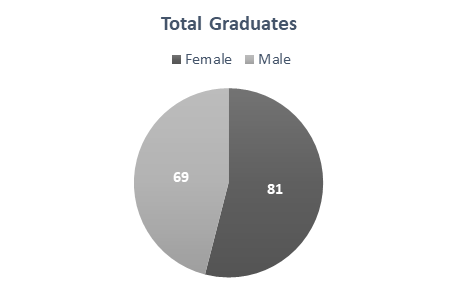

Women’s Graduation Rate — Academic Year 2023–2024
In the academic year 2023–2024, the university awarded degrees to a total of 150 graduates distributed by subject area , of whom 81 were women—yielding an institution-wide female graduation rate of 54.0%.
Female graduates held the majority in five of the six colleges: the College of Public Health recorded the highest female representation at 96.8% (30 of 31 graduates), followed by the College of Law & Political Sciences at 71.4% (5 of 7), the College of Arts and Science at 57.9% (11 of 19), and the College of Business at 52.4% (11 of 21), while the College of Architecture & Design stood just below parity at 45.5% (10 of 22). The College of Engineering, consistent with a well-documented global pattern in STEM disciplines, reported a female graduation rate of 28.0% (14 of 50), representing the most significant area for targeted equity intervention.
Overall, the university’s 54.0% female graduation rate exceeds both the UNESCO global average for women in tertiary education (approximately 53%) and the institutional parity target, demonstrating the university’s commitment to gender equality in higher education.
Female Graduation Trends Across Colleges (2021–2025)
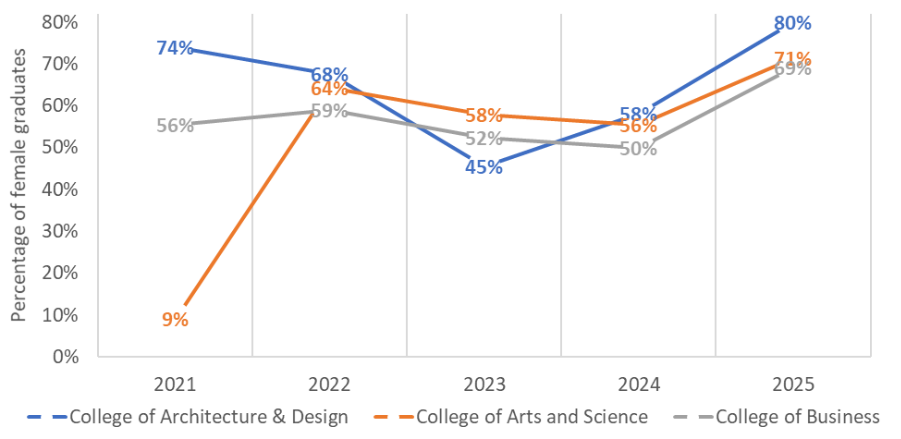
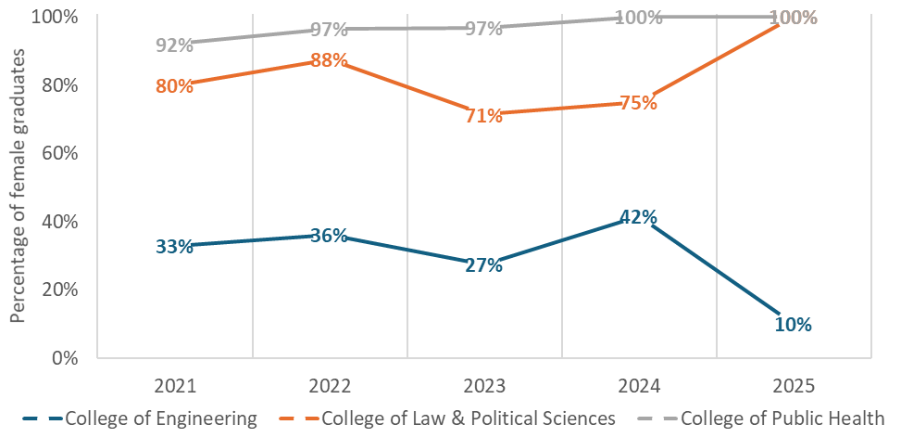
Across the 2021–2025 reporting period, women accounted for 422 of 725 graduates (58.2%), consistently representing approximately half or more of all graduates distributed by subject area. These results demonstrate sustained female participation and successful completion across the University's academic programmes.
Phoenicia University leverages its PU Alumni Portal to systematically monitor long-term graduation outcomes, career progression, and leadership advancement for women in direct alignment with UN SDG 5. Central to this strategy is PU Alumni Mentorship Track — A dedicated mentoring track within PUCC pairing students from underrepresented backgrounds with PU alumni who share similar backgrounds and have successfully transitioned into the workforce. This includes connecting female students in STEM fields with alumnae already established in those industries, offering guidance grounded in lived experience and access to a professional network they may not otherwise have.
Through the Phoenicia University Alumni Association PUAA and active career tracking services, female and male graduates maintain lifelong connections that feed directly into this ecosystem. Demonstrating this long-term progression in technical fields, Myrna Kdouh (Class of 2019, Civil and Environmental Engineering) has advanced from an Associate to Senior Associate and Consultant within KPMG Middle East's Sustainability Solutions team, driving regional sustainability initiatives. Similarly, Farah Saleh (Class of 2021, Petroleum Engineering) currently serves as a Senior Associate Data Scientist at PwC Luxembourg, applying advanced cloud architecture, natural language processing models, and generative AI to enterprise solutions. Alumni Spotlight | Phoenicia University
Furthermore, our alumni enrich our academic community by choosing to Volunteer their time, mentorship, and expertise to support the next generation of female leaders and ensure the continued success of Phoenicia University.
5.6.8 Policies protecting those reporting discrimination
Phoenicia University (PU) maintains explicit institutional protections to safeguard all community members who report discrimination, harassment, or misconduct.Under Section 27 (Protection Against Retaliation) of both the Staff and Faculty Nondiscrimination, Discriminatory Harassment and Retaliation Policy and the Student Nondiscrimination, Discriminatory Harassment and Retaliation Policy, the University strictly prohibits reprisal against any individual for reporting a concern in good faith, filing a complaint, participating in an investigation, providing evidence, acting as a witness, supporting a peer, or refusing to engage in prohibited conduct. Crucially, retaliation is classified as an independent policy violation subject to formal disciplinary action, regardless of the ultimate outcome of the underlying complaint. Individuals experiencing retaliation are granted direct access to established reporting and grievance procedures, ensuring an equitable, confidential, and protected process for all disclosures.
5.6.9 Paternity Policy
Phoenicia University (PU) actively promotes shared parental responsibility and gender equity through its formal Maternity Paternity Family Care Leave Policy (Sections 6.1–6.3), which entitles all full-time male faculty and staff members to three consecutive calendar days of fully paid paternity leave following the birth of a child.
The policy strictly prohibits discrimination, retaliation, or professional disadvantage for employees taking paternity leave. To assist fathers in balancing early childcare responsibilities with professional duties, the institution provides options for flexible work arrangements, temporary schedule modifications, and coordinated workload management post-leave, subject to operational feasibility.
In addition to paternity leave, male employees are entitled to Family Care Leave (Section 7), enabling them to request temporary leave, modified workloads, and flexible scheduling to support immediate family members experiencing serious medical conditions or care needs.
Policy implementation is governed by the Human Resources Department and overseen by the Quality Assurance and Accreditation Office to align with institutional quality standards.
Colleges
Contact info
Phoenicia University
Main Campus
District of Zahrani
South Lebanon
Tel.: +961 7 420 720
E-mail: info@pu.edu.lb
Main Campus
District of Zahrani
South Lebanon
Tel.: +961 7 420 720
E-mail: info@pu.edu.lb