
SDG 1: No Poverty
Phoenicia University (PU) is committed to advancing SDG 1 by promoting equitable access to quality education as a pathway out of poverty. Through scholarships, financial aid, and community outreach initiatives, PU works to remove financial barriers to higher education and support students and communities in South Lebanon, one of the country's most economically vulnerable regions. This commitment reflects the University's broader mission of making quality education accessible to all, regardless of socioeconomic background.
1.2 Low-income students receiving financial aid
| Indicator | Number |
|---|---|
| Number of students | 1262 |
| Number of low-income students receiving financial aid | 825 |
Proportion of students receiving financial aid is 65.37%.
1.3.1 Admission Target for bottom financial quintile
Phoenicia University has implemented a financial aid strategy to enhance access to higher education for students from the most financially disadvantaged backgrounds in Lebanon. Through its Financial Aid and Scholarship Program Financial Aid and Scholarship | Phoenicia University PU targets applicants from the bottom 20% of household income in the country, reflecting the University's mission to ensure that quality education remains accessible regardless of financial circumstances.
This target and its underlying methodology are formalized in PU's Financial Aid and Scholarship Policy, summarized below:
PU's Financial Aid and Scholarship Policy give institutional priority to students from the bottom 20% of household income in their country of origin and commits to measurable targets for their admission, retention, graduation, and completion (Section 2). Section 7 sets this numerically: at least 20% of each incoming cohort must be verified as belonging to the bottom income quintile, reported at the close of the admissions cycle.
Every applicant undergoes an individualized Financial Need Assessment before admission or award decisions are finalized (Section 9.2), and verified students are routed into a dedicated entry pathway, the Social Welfare Full Scholarship (Section 6.3) - with the Work-Study Program available from entry to support completion (Section 6.5). An independent Financial Aid Committee reviews all admission-linked aid decisions, with mandatory recusal in conflicts of interest (Section 3).
This commitment is particularly significant given PU's location in the Zahrani district of South Lebanon, one of the country's most economically disadvantaged regions, which continues to face compounding challenges from Lebanon's economic crisis and the recent escalation. In line with this, all financial aid applications are reviewed by a dedicated committee tasked with objectively identifying and prioritizing the most deserving cases based on documented financial need.
Phoenicia University collects household income data from all financial aid applicants via its Financial aid application, feeding into PU's Proxy Means Test (PMT), covering income, household size, housing, assets, employment, and district-level deprivation. PU sets its bottom-quintile cutoff using the World Bank Poverty and Inequality Platform PIP's Decile 2 upper bound for Lebanon, the most recent year available at the time of calculation.
PU aims to ensure that at least 20% of admitted students each year come from the lowest 20% income bracket in the country. In the 2023/2024 academic year, students from the bottom income quintile were admitted under this initiative, representing 22.21% of new enrollments.
This reflects PU's ongoing efforts to expand access to higher education and to support social mobility in a region facing significant economic hardship.
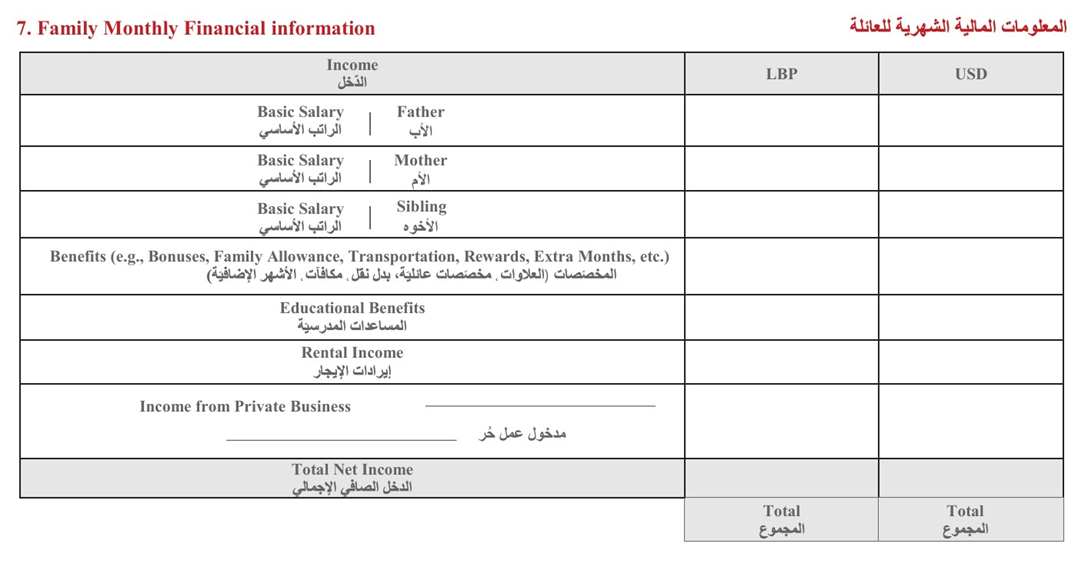
Excerpt from PU's Financial Aid Application form requesting household income data, used to identify students in the bottom income quintile.
1.3.2 Graduation Target for bottom financial quintile
Phoenicia University is firm in its commitment to ensuring that students from the lowest household income groups, including the bottom 20%, do not merely gain access to higher education, but are fully equipped to complete their degrees and graduate successfully. To achieve these institutional retention and completion targets, PU has established a robust, multi-layered student support ecosystem - through its Financial Aid and Scholarship Program - that addresses both financial limitations and personal development.
PU collects household income data from all financial aid applicants Financial aid application. to classify students by income groups. Once classified, students in the bottom quintile are flagged in PU's student information system, allowing the university to track their academic performance, retention, and graduation timeline as a distinct cohort each year, from admission through to degree completion. This data-driven tracking allows PU's Financial Aid Office and academic advising units to identify at-risk students early and direct support services (work-study program, peer mentoring, academic advising per college) specifically toward this population. Among these, the Work-Study Program allows bottom-quintile, low-income, and Low and Lower-Middle Income Countries (LLMICs) students to earn a limited number of paid work hours per week, placed in administrative offices, library services, or research and academic assistance, with earnings applied directly against their tuition-fee balance, alongside student mentorship program and academic advising per college.
This target and its underlying methodology are formalized in PU's Financial Aid and Scholarship Policy, summarized below:
PU's Financial Aid and Scholarship Policy formally commit to reporting measurable targets for the retention, graduation, and completion of financially disadvantaged students (Section 2), and sets this numerically at minimum 80% cohort completion rate for bottom-quintile students, tracked per cohort (Section 7).
To sustain students through to completion, need-based awards are reassessed annually against continued eligibility and academic standing (Section 9.5), and an interest-free tuition loan mechanism protects continuity for students facing temporary cash-flow difficulty (Section 6.4). Beyond tuition, PU provides wraparound support — food, housing, transport, legal/advisory services, and academic mentoring, technology access and fee waivers beyond tuition— for bottom-quintile, low-income, and low and lower-middle income countries (LLMICs) students, explicitly framed as addressing poverty-related barriers to completion (Section 8); at-risk and bottom-quintile students are also paired with faculty or peer mentors to support progression toward these graduation targets.
PU aims for a graduation rate of minimum 80% among students from the lowest 20% income groups. In 2023–2024, the graduation completion rate for the bottom financial quintile was 85.71%, a gap the University actively monitors through its cohort-tracking system, directing at-risk students toward targeted academic and work-study support to close it in future cohorts.
1.3.3 Low-income Student support programs
Phoenicia University is deeply invested in sustaining an academic environment where economic limitations do not limit students' future. Through its comprehensive financial aid structures, PU provides a range of support programs and services (including food, housing, transportation, legal and advisory services, academic mentoring, health services, and free counseling) to enable students from the bottom income quintile, low-income households, and LLMICs to complete their studies.
These efforts are further complemented by PU's membership in the College Board (2024), which connects students with additional financial aid opportunities, scholarship search tools, and test preparation resources, broadening the pathways available to students in preparing for and financing their higher education.
Low-Income Student Support Programs (Section 6, PU Financial Aid Policy)
| Program | Basis of Award | Primary Eligible Population | Key Benefit | Reference |
|---|---|---|---|---|
| Need/Merit-Based Financial Aid Grants | Demonstrated financial need & satisfactory academic standing | Low-income Lebanese students and LLMICs students | Partial or full tuition grant based on individual needs assessment. | Section 6.2 |
| Social Welfare Full Scholarship | Severe financial hardship; | Students verified as belonging to the bottom 20% of national household income distribution | Full tuition scholarship & access to wraparound support package | Section 6.3 |
| Loan-Based Financial Aid | Temporary cash-flow difficulty | Enrolled students in good academic and disciplinary standing | Interest-free extension of payment deadline via individualized repayment plan; no penalty or late fee while plan is honored | Section 6.4 |
| Work-Study Program | Financial need & capacity to commit to agreed weekly work hours without academic detriment | Bottom-quintile, low-income, and LLMICs students | Limited paid work hours per week; earnings applied directly to tuition-fee balance | Section 6.5 |
Wraparound Support for Bottom-Quintile, Low-Income and LLMICs Students (Section 8, PU Financial Aid Policy)
In addition to the scholarships and grants described in Section 6, PU provides the following support to enable students from the bottom income quintile, low-income households, and LLMICs to complete their studies:
- Food: A 10% subsidy is provided for campus dining services to verified bottom-quintile students experiencing food insecurity.
- Housing support: subsidized or free on-campus dormitory placement.
- Transport support: subsidies or provision, available on assessed need to bottom-quintile students; (Section 6.1, PU Financial Aid Policy)
- Legal and advisory services: access to PU's Global Outreach and International Affairs (GOIA) Office for support with residency, visa (for LLMICs students), and other administrative or legal obstacles to continued enrolment;
- Academic mentoring: pairing of at-risk, bottom-quintile and LLMICs students with faculty or peer mentors to support academic progression toward the graduation/completion targets in Section 7, PU Financial-Aid-Policy.
- Technology Access: Provision of loaned laptops, complete with necessary accessories, to bottom-quintile, low-income, and LLMICs students to ensure equitable access to hybrid and remote coursework.
- Fee waivers: Waivers of academic and administrative fees beyond tuition, extended to bottom-quintile, low-income, and LLMICs students to reduce the cumulative financial burden of continued enrolment.
Counseling Support
The Counseling Center provides free, confidential counseling to all staff and students, supporting wellbeing, stress management, and academic and personal life skills. Counseling is a confidential and collaborative process between the individual and a trained professional, helping them understand their concerns, set realistic goals, and develop healthy coping strategies.
The service places particular focus on groups most at risk of being underserved, including women, individuals with disabilities, members of ethnic and national minority backgrounds, and those from low-income backgrounds.
For students and employees navigating anxiety, stress, or other mental health difficulties, the Center provides a confidential space to seek support without fear of stigma or judgment, with trained professionals guiding individuals toward appropriate coping strategies and, where needed, referral to specialized care. For those facing financial hardship, counseling also serves as an entry point to PU's broader support network — including the Minorities Center's financial hardship pathway and the Learning Development Center — helping individuals address stress or setbacks before they affect academic or work performance. For women navigating career or educational interruptions, the Center works alongside the Minorities Center's Women's Continuity Pathway to provide coordinated emotional and practical support throughout the process.
These services are offered through a partnership with the Lebanese Welfare Association for the Handicapped (LWAH).
At PU, we believe that seeking support reflects strength and self-awareness. Our team is committed to listening, supporting, and guiding every member of our community throughout their journey. Anyone who wishes to schedule a session is welcome to contact the Counseling Center at counselor@pu.edu.lb to arrange a suitable date and time.
PU partnered with LWAH to launch a free Mental Health Hotline, operated through the Counseling Center, for students and the wider PU community — including women, individuals with disabilities, members of ethnic and national minority backgrounds, and those from low-income backgrounds.
The hotline offers an accessible, no-cost, and confidential first point of contact for anyone experiencing emotional distress, anxiety, or other mental health concerns, particularly valuable for individuals who may otherwise face financial, social, or logistical barriers to seeking help. Support is provided by trained professionals, with referrals to further care where needed.
Health and Wellbeing Services
The Health Care Center supports the wellbeing of the PU community by providing primary care for injury or sudden illness, with a qualified health practitioner delivering initial assessment and emergency procedures while awaiting transfer to a hospital and ensuring occupational health and safety (OHS) standards are met on campus.
Free Healthcare Access Through PU's partnership with LWAH, PU students and the wider PU community have access to free healthcare services at LWAH's facilities, extending medical support beyond what is available through the HCC.
Minorities Center: Promoting Inclusion, Belonging and Equal Opportunity
Under the supervision of the University Diversity Office (UDO), the Minorities Center fosters an inclusive and equitable university environment that promotes belonging and equal opportunity for all members of the university community.
The Center works to identify and address barriers that may limit individuals’ access, participation, and full engagement in university life. Through coordinated support and collaboration with relevant university departments, the Center promotes inclusion, equity, and access to essential resources and services.
The Center also monitors emerging needs among underserved groups and works with university units to ensure timely, equitable, and responsive solutions. Through these efforts, it contributes to building a more inclusive campus where all individuals have the opportunity to participate and succeed.
Other Support Pathways
Beyond the pathways offered, the Minorities Center serves as a point of contact for other underrepresented groups, including students and employees facing financial hardship and international or ethnic minority students navigating integration challenges. In these cases, Center staff connect individuals to the relevant university office — financial aid, student affairs, or GOIA office — to ensure their concerns are addressed through the appropriate channel.
Students and employees from low-income households and the bottom income quintile are recognized as facing compounded financial, academic, and social barriers to completing their studies or sustaining employment. The Center works to identify the specific support required in each case, which may include emergency financial assistance, adjusted or deferred tuition payment arrangements, connection to work-study or income-support opportunities, or referral to external welfare and NGO partners. Center staff coordinate directly with the financial aid office to conduct a thorough assessment of individual needs and to secure timely, tailored support, ensuring that financial hardship does not become a barrier to academic or professional success.
1.3.4 Bottom financial quintile student support
Beyond setting admission and completion targets for students from the bottom 20% income group, PU operates a coordinated set of programmes and initiatives specifically designed to support these students, and students from LLMICs, throughout their studies. These programmes address financial, academic, health, and personal barriers that can otherwise prevent completion, recognizing that poverty-related obstacles extend well beyond tuition fees alone.
In addition to the Financial Aid support programmes, Wraparound support, Counseling Center, Health Care Center, Minorities center and PU's partnership with LWAH, elaborated in Sections 1.3.1, 1.3.2, and 1.3.3, PU also operates a Student Mentorship Program to support these students academically.
Student Mentorship Program
PU operates a university-wide Student Mentorship Program that pairs first-year students with trained peer or alumnae mentors to support their academic transition, engagement, personal development, and successful integration into university life. The programme provides guidance on academic expectations, campus resources, study skills, and student life, while fostering a supportive learning community. The Program is hosted in collaboration with the Student Affairs Office and the University Diversity Office.
Building on this institutional programme, the program has a dedicated mentoring track that pairs first-year students from the bottom income quintile and LLMICs with senior peer mentors — ideally upperclassmen who have navigated similar financial or transitional challenges themselves — during their first year at PU. In the program scheme, we aim for a minimum 1:4 mentor-to-mentee ratio. Mentors on this track are trained to check in on their mentees' financial status and to encourage students to report financial difficulties early. This allows the university to respond quickly, connecting students to support such as Work-Study, the Counseling Center, and wraparound services before challenges lead to withdrawal.
In the 2023–2024 academic year, approximately 50% of senior mentors across both categories — bottom-quintile and LLMIC students — were engaged in mentoring newly admitted first-year students.
Technology Access
Recognizing that poverty-related barriers to completing a university education extend well beyond tuition costs, PU complements the scholarships and grants outlined in Section 6 with a coordinated package of wraparound support. This includes technology access through a laptop lending program to support hybrid coursework, reserved specifically for the three groups most affected by financial hardship: low-income students, bottom-quintile students, and LLMICs students. (Section 8. Financial Aid and Scholarship Policy)
Fee Waivers Beyond Tuition
In addition to technology access, PU provides fee waivers beyond tuition as part of its wraparound support package, addressing poverty-related barriers that extend beyond the cost of tuition alone. These waivers are reserved specifically for the three groups most affected by financial hardship: low-income students, bottom-quintile students, and LLMICs students. (Section 8. Financial Aid and Scholarship Policy)
1.3.5 Low or Lower-Middle Income Countries Student Support
Beyond the admission targets, completion targets, financial aid programs, and academic and wraparound support described above, PU operates a coordinated set of schemes specifically designed to support students from low- and lower-middle-income countries (LLMICs) throughout their studies. These schemes recognize that LLMICs students face distinct barriers — including visa and residency requirements, distance from family support networks, and unfamiliarity with local systems — in addition to the financial and academic barriers already addressed for bottom-quintile students.
All support services and schemes elaborated in Sections 1.3.1, 1.3.2, 1.3.3, and 1.3.4 — including the Financial Aid Support Programs, wraparound support, the Counseling Center, health and wellbeing services, the Minorities Center, the Student Mentorship Program, and PU's partnership with LWAH — also apply to students from LLMICs.
International Outreach School Visits
In addition to the schemes outlined above, PU's Global Outreach and International Affairs (GOIA) Office operates an international outreach initiative specifically targeting prospective students in West Africa, a region encompassing multiple Low and Lower-Middle Income-classified countries. Launched five years ago, the initiative connects PU with students who may otherwise have limited access to information about higher education opportunities abroad.
Each year, the GOIA Office visits approximately six to seven schools, introducing students to study opportunities at PU and the available admission pathways. Over the past five years, the initiative has reached hundreds of students across West Africa, with a number of participants subsequently enrolling at PU — establishing the school visits as a direct pathway connecting LLMICs students to higher education and the University's broader support ecosystem.
GOIA Office Initiatives | Phoenicia University
Additional resources:
Student Handbook
Policies and Procedures
Financial Aid and Scholarhsip Policy
Financial Aid and Scholarship
Global Outreach and International Affairs
Counseling Center
Health Care Center
Minorities Center
Student Affairs Office
1.4.1 Local Start-Up Assistance
PU is committed to addressing regional economic challenges and encouraging local poverty alleviation by driving community-centered innovation and entrepreneurship. Recognizing that financial stability thrives on sustainable business development, the university actively assists the local community in transforming inventive and promising ideas into viable, self-sustaining ventures.
At the forefront of these efforts is the Phoenicia University Incubator (PUI) the first start-up incubator in South Lebanon. Through PUI, the university helps support the start-up of financially and socially sustainable businesses in the local community. Eligibility extends beyond the PU community to include external applicants from the wider public (PU Incubator Policy, Admission and Eligibility), ensuring the Incubator's support reaches local entrepreneurs.
Facilities: Incubatees have access to workspace, including office/desk space, co-working areas, and meeting rooms; internet and computing services; university laboratories, workshops, and specialized equipment; and equipment required for prototyping or research, subject to availability and safety rules (PU Incubator Policy, Services, Infrastructure, and Resources, §1, "Physical Resources"). Office and co-working space are provided free of charge, waived at market rental value, and access to specialized laboratory equipment and software licenses is provided free of charge as an in-kind contribution (PU Incubator Policy, Services, Infrastructure, and Resources, §6, "In-Kind Financial Contributions").
Training: The Incubator delivers workshops on business planning, financial modeling, marketing, regulatory requirements, and go-to-market strategy, alongside training on intellectual property, commercialization, and legal essentials, with structured capacity-building programmes including bootcamps, masterclasses, and seminars (PU Incubator Policy, Services, Infrastructure, and Resources, §4, "Training, Workshops & Capacity Building"). This is provided free of charge as an in-kind contribution (PU Incubator Policy, Services, Infrastructure, and Resources, §6, "In-Kind Financial Contributions").
Mentorship: Incubatees receive one-to-one or group mentoring from faculty, alumni entrepreneurs, and industry professionals, covering business development, product strategy, team development, and operational planning, alongside regular advisory clinics on finance, marketing, regulatory compliance, and commercial strategy (PU Incubator Policy, Services, Infrastructure, and Resources, §3, "Mentorship & Advisory Services"). This is delivered as in-kind advisory support at no cost to incubatees (PU Incubator Policy, Services, Infrastructure, and Resources, §6, "In-Kind Financial Contributions").
This support is formalized in PU's Incubator Policy
Beyond this standing infrastructure, PUI runs a periodic program of public outreach events that connect students and community entrepreneurs to the incubator and to one another.
PU Incubator Info Session Series for the Local Community
PU's Incubator (PUI) holds free, recurring information sessions open to students and the local community on joining its incubation ecosystem. On the 14th of December 2023, a session welcomed 20 attendees and covered mentoring tracks, training opportunities, and access to PUI's shared facilities and 13 high-tech laboratories. It was led by PUI Advisory Board members Dr. Ahmad Hijazi (business planning) and Dr. Dima Basma (legal/regulatory guidance), offering direct mentorship to help attendees develop structured, actionable projects.
PU Incubator Info Session Series for the Local Community | Phoenicia University
PU Incubator: Building Skills, Empowering Entrepreneurs
On September 1st , 2024, the PU incubator hosted training sessions as part of its outreach initiative "Explore Your Entrepreneurial Potential with PUI," welcoming aspiring entrepreneurs from the local community. Advisory Board members Dr. Ahmad Hijazi (business admission and incubation process) and Dr. Dima Basma (legal considerations including IP protection, registration, and compliance) led the sessions, followed by a hands-on business stress test where participants tested their ideas against real-world assumptions. Both deans committed to ongoing one-on-one consultancy for attendees. As a result, 23 students and community members joined as new Incubator members, gaining access to PUI's mentorship, training, and facility resources.
PU Incubator: Building Skills, Empowering Entrepreneurs | Phoenicia University
Women Empowerment Market
On March 25, 2024, the Women Empowerment Club at Phoenicia University, in partnership with PUI, hosted the Women Empowerment Market — a free, on-campus platform supporting female students and community members running small businesses. At least 11 female-led ventures, spanning handcrafted accessories, home-baked pastries, and artisanal goods, took part at no cost to participants, gaining direct customer access, hands-on sales experience, and greater visibility. The initiative reflects PUI's commitment to socially sustainable, community-rooted entrepreneurship led by women.
Women Empowerment Market | Phoenicia University
Idea Fair: PU Students and Community Pitching Platform
Organized by PUI, the Idea Fair is an annual public pitch event where students and young innovators from the local community present business ideas, projects, and inventions to a panel of faculty and industry mentors, free of charge.
Ten ideas were presented on the 27th April 2024, including an inventory management system, a clean electricity solution harnessing oceanic power, a health behavior management application, and an underfloor heating system powered by speedbumps.
The PU Advisory Board evaluated the submitted ideas against criteria spanning originality and creativity, market potential and scalability, and team feasibility, and the winning team, whose clean electricity solution harnesses the power of ocean waves, was invited to join PUI's incubation track following the event, translating their pitch into structured, hands-on mentorship and resources to develop their idea into a viable venture.
The event serves as a direct feeder into PUI's incubation pipeline, connecting student and young community innovators with the free mentorship, training, and structured support needed to move ideas from concept toward financially and socially sustainable ventures.
Idea Fair: PU Students and Community Pitching Platform | Phoenicia University
Inspirational Talk with Mr. Pierre Bachir, R&D Manager of "Bouza Bachir"
In October 2023, the Business Society of PU, in collaboration with the Student Affairs Department, hosted a free, public talk with Mr. Pierre Bachir, R&D Manager of Bouza Bachir, one of Lebanon's leading ice cream brands. Open to both students and the community, the session covered managing a family-owned business, scaling into international markets, and navigating entrepreneurship within Lebanon's economic landscape. The talk also highlighted the importance of collaboration between academia, students, and industry in strengthening Lebanon's entrepreneurial ecosystem, reinforcing PUI's commitment to accessible, practical learning opportunities.
Inspirational Talk with Mr. Pierre Bachir, R&D Manager of "Bouza Bachir" | Phoenicia University
Phoenicia University Celebrating Innovation at the 2024 Technology and Science Fair - April 2024
Phoenicia University was filled with creativity and futuristic visions at the PU Technology and Science Fair 2024 for schools, held on campus on Friday, April 26, 2024. The event, which featured projects from several schools, concluded in a triumphant win for Cadmous College with their project "City 2.0: Unveiling the Future of Smart and Sustainable Urban Living."
The project was part of a competition that saw innovative entries from numerous participating schools, but it was "City 2.0" that stood out for its comprehensive approach and practical applications in creating smarter, more sustainable cities.
This pioneering project earned Cadmous College's students — Mahdi Hammoud, Naboukhad Nassar Ali Hussein, and Alaa Al Moustapha — first place for their notable demonstration of how technology can be integrated into urban environments to enhance public safety, promote active citizen participation, and improve overall urban efficiency. In recognition of their solution-oriented thinking and potential to contribute to technological advancements in urban development, the winning teams were awarded a 70% scholarship to Phoenicia University and were granted a comprehensive support package to help translate their idea into a viable business, including PU Incubator membership, access to university facilities, hands-on training and mentorship to develop their business concept.
The judging panel included esteemed faculty members Dr. Majeda Sharafeddine, Dean of the College of Arts and Sciences; Dr. Ahmad Hijazi, Dean of the College of Business; and Dr. Zahi Abdul Sater, Dean of the College of Public Health, who were tasked with the careful selection of the top projects.
The 2024 PU Technology and Science Fair for schools not only showcased the talents of young innovators but also highlighted the university's commitment to fostering educational excellence and supporting the next generation of scientists and technologists. Through initiatives like this, PU Incubator continues to provide the local community with meaningful support, helping promising ideas grow into sustainable, community-rooted businesses.
1.4.2 Local start up financial assistance
The practical efficacy of PUI is demonstrated by its diverse portfolio of actively operating local businesses. Since its establishment, the Incubator has supported the founding and development of a range of local businesses, spanning the founding years 2017 through 2025. Of these, 61% have remained operational for five years or more, demonstrating durable, long-term economic impact from the Incubator's support.
The portfolio reflects a diversified spread across 17 distinct micro-sectors, grouped into five broader categories: health & wellbeing, food security & food business, retail & craft livelihoods, marketing & creative services, and engineering, manufacturing & technology.
The Incubator provides financial assistance in the form of in-kind contributions, rather than direct or seed funding (PU Incubator Policy, Access to Funding Resources).
This includes waived office/co-working rent, free legal consultation, free accounting support in the start-up's first year, free workshops and training, free access to lab equipment and software, and competition or pitch awards at university events (PU Incubator Policy, §6, "In-Kind Financial Contributions").
The Incubator also connects incubatees with external funding opportunities, including grants coordinated through the University's Grants Office (PU Incubator Policy, §7, "Access to External Funding").
This assistance is formalized in PU's Incubator Policy.
PUI milestones
Building The Scaling Crew: A PU Incubator Success Story
In 2021, Phoenicia University alumnus Karim Hoteit joined the PU Incubator (PUI) with a vision to help businesses increase revenue through sales-driven content. His approach began with in-depth competitor and product-market analysis to identify each business's unique selling point, followed by the development of a tailored content strategy built around it. This vision evolved into "The Scaling Crew."
Between 2022 and 2024, Karim benefited from the mentorship, guidance, and training provided by PUI's Advisory Board, alongside access to the Incubator's equipment and workspaces. Under the Board's guidance, he expanded his understanding of marketing beyond conventional approaches, strengthening key aspects of his business. The Advisory Board further supported his development in leadership and team management, equipping him with the skills to lead both a team and a growing local enterprise. Karim also received legal advisory support to ensure the business was properly established.
Since launching in February 2022, The Scaling Crew has grown into a fully self-sustaining enterprise generating five-figure monthly revenue. Beyond its commercial success, the business produces awareness content that helps others identify and pursue job opportunities, extending its impact beyond the company to the wider community. Reflecting on his experience, Karim notes: "The experience of the PUI Advisory Board easily guided me to build a solid foundation and helped in scaling the business."
https://pu.edu.lb/building-scaling-crew-pu-incubator-success-story
1.4.3 Programmes for services access
PU continues to uphold its commitment to community well-being by organizing training and outreach programs that directly improve access to basic services for all, particularly for vulnerable and underserved populations. These initiatives are coordinated across the University, through academic departments, student clubs and societies, and in partnership with external organizations such as LWAH, reflecting an institution-wide commitment to community outreach rather than isolated student activity.
Conducted on an ongoing basis, these directly supplied initiatives enhance access to essential health, food, clothing, and inclusive support services, supporting inclusive growth and community resilience in line with the United Nations Sustainable Development Goals (SDGs).
PU Christmas Market
Phoenicia University's Christmas Market, held annually to close the semester as part of its ongoing commitment to improving access to basic services for vulnerable populations, directly channels resources to those in need. PU clubs and societies organize food booths, merchandise stalls, and activities, with all proceeds going directly toward supporting displaced families and individuals, providing food and essential non-food supplies to those facing poverty and displacement. As an annual initiative, the market proceeds have benefited an estimated 1,200 to 1,500 individuals to date. As a recurring, directly supplied initiative, the market reflects PU's institution-wide commitment to equitable access to basic services.
PU Christmas Market | Phoenicia University
Clothes Donation Drive
The Change Club organized a Clothes Donation drive that has collected and distributed clothing to individuals and families in need, addressing a fundamental basic necessity for vulnerable community members. Donations are gathered from students, faculty, and staff across campus through collection points set up for the drive, before being sorted and distributed directly to recipients. Distribution is conducted based on assessed need, ensuring that support reaches those most economically disadvantaged. To date, the initiative has reached approximately 2,000 individuals across the local community.
As an ongoing, directly supplied initiative, the drive reflects Phoenicia University's continued commitment to improving access to basic services for underserved populations, complementing the university's broader, recurring programme of community support activities carried out throughout the year.
Clothes Donation Drive | Phoenicia University
Diabetes Awareness and Free Diagnostic Campaign
Since 2023, Phoenicia University, in partnership with the Lebanese Welfare Association for the Handicapped (LWAH), has run an ongoing Diabetes Awareness and Free Diagnostic Campaign, directly providing free education, diagnostic services, and continuous follow-up support to students and the wider community. Led by qualified physicians and nutritionists, the programme delivers educational sessions on diabetes risk factors, prevention, and management, alongside free consultations, comprehensive screening, and glucometers for ongoing self-management. Participants receive tailored follow-up care and referrals based on screening results.
In 2024, the campaign directly supported 49 individuals living with Type 1 diabetes and 35 individuals living with Type 2 diabetes, with additional cases continuing to be identified as the initiative remains active. The programme reflects Phoenicia University's sustained commitment to improving access to essential health services for the local community.
Diabetes Awareness and Free Diagnostic Campaign | Phoenicia University
Mobile Clinics
Since 2023, Phoenicia University, in partnership with the Lebanese Welfare Association for the Handicapped (LWAH), has run mobile medical clinics directly providing essential healthcare to underserved communities across Lebanon. Between 2023 and 2024, the initiative reached approximately 1,500–2,000 beneficiaries through municipal partnerships, alongside more than eight centers serving displaced communities in Beirut, benefiting around 4,200 individuals.
Supervised by faculty from PU's College of Public Health alongside LWAH medical teams, the clinics provide community health education, on-site diagnosis and screening, and free access to essential medications, directly reducing financial barriers to care. The initiative reflects Phoenicia University's sustained commitment to improving access to basic health services for vulnerable communities.
Mobile Clinics | Phoenicia University
Distribution of Campus-Grown Produce
Phoenicia University cultivates and distributes seasonal agricultural produce — including olive oil and avocados — grown using University resources and land, reflecting its ongoing commitment to sustainability and community support. The University's campus includes 9 greenhouses to approximately 1,000 avocado trees and 200 olive trees, forming the basis of this ongoing agricultural initiative.
This initiative demonstrates how sustainable, locally sourced farming can be integrated into everyday institutional practice, while reducing reliance on external supply chains.
The collected produce is distributed to university staff and lower-income members of the surrounding community, helping to improve access to basic food resources. Beyond its immediate impact, the program showcases the practical value of sustainable, locally produced goods and reinforces PU's role as an active, engaged member of the community it serves.
Distribution of Campus-Grown Produce | Phoenicia University
Water Quality Testing
In response to water contamination concerns and associated health risks—including Lebanon's cholera outbreak—Phoenicia University's Civil and Environmental Engineering Department, in partnership with the Laboratories Department, has provided an uninterrupted water quality testing service.
Access to clean and safe water is a fundamental basic service. By directly testing bacteriological parameters (including Cholera, Fecal Coliform, and Total Coliform), PU equips local entities, communities, and the private sector with actionable scientific data. This continuous institutional response improves public health outcomes, enables rapid containment of contaminants, and guarantees sustained access to safe basic resources.
Water Quality Testing | Phoenicia University
Water Testing Services | Phoenicia University
1.4.4 Policy addressing poverty
Phoenicia University recognises the role of higher education institutions in addressing poverty through research, professional expertise, and policy engagement. In support of UN SDG 1 (No Poverty), the university adopts the Anti-Poverty Policy, which provides a framework for contributing academic expertise, research, and community partnerships to poverty-reduction initiatives.
PU contributes to policy making through faculty involvement in consultations, technical advice, and expert committees, and by providing evidence-based recommendations to governmental bodies, municipalities, civil society organizations, and international organizations. Through strategic partnerships with these same actors, the University contributes academic expertise and professional consultation to the design, implementation, and evaluation of poverty-related programmes.
Phoenicia University’s Global Policy Participation in Addressing Poverty
Since 2018, Phoenicia University, has been a member of the United Nations Academic Impact (UNAI), formally committing to ten UN principles, among them a dedicated commitment to addressing poverty. This membership reflects PU's alignment with global policy frameworks on poverty eradication, guiding the university's approach to embedding poverty-focused priorities into its education, research, and community outreach initiatives. Through this UN-recognized commitment, PU continues to support programs that extend access to resources, services, and opportunities for vulnerable and underserved communities.
Phoenicia University membership with United Nations Academic Impact. | Phoenicia University
UNAI Member List - 2023
UNAI Member List 2025
PU Faculty Support LWAH's Policy Engagement with ECOSOC
Phoenicia University contributes faculty expertise to global poverty policy discussions through its partnership with the Lebanese Welfare Association for the Handicapped (LWAH). Under Clause 3.12 of the PU–LWAH partnership agreement, LWAH consults PU's Faculty of Law and Political Science on the development of institutional and public-policy positions relating to disability rights and related matters, with supervised postgraduate law students assisting on research and drafting under faculty direction.
LWAH has held special consultative status with the UN Economic and Social Council (ECOSOC) — the UN's principal organ for coordinating global economic, social, and environmental policy — since 2000, giving it standing to participate in global policy processes such as the High-Level Political Forum's review of the Sustainable Development Goals, including SDG 1 (No Poverty).
This connection matters for poverty policy: persons with disabilities are disproportionately represented among the world's poor, facing higher healthcare costs, reduced access to education and employment, and exclusion from social protection systems. Disability-rights policy and poverty reduction policy are therefore mutually reinforcing.
Through this consultation mechanism, PU's Faculty of Law and Political Science contributes directly to LWAH's disability-rights policy positions, situating PU's academic expertise within the work of an organization holding special consultative status with ECOSOC and active in global SDG1 review processes.
Regional and National Poverty Policy Initiative – Dr. Hassan Hamie
Since 2018, Dr. Hassan Hamie has been contributing to teaching and academic activities at Phoenicia University, primarily in the field of engineering. Alongside his academic engagement, since joining the United Nations Economic and Social Commission for Western Asia (ESCWA) in 2021, Dr. Hamie has served in various research and policy roles, including Research Assistant and Associate Social Affairs Officer, contributing to regional initiatives on social protection and poverty reduction. His work involves supporting the design and implementation of social development strategies across multiple Arab States, in collaboration with national ministries, regional stakeholders, and development partners.
While his professional work focuses on social and economic development policy, his academic contributions at Phoenicia University are centered on engineering education and student capacity development. Through teaching, mentoring, and knowledge sharing, he contributes to the University's commitment to advancing high-quality education and fostering the technical competencies required for sustainable development and innovation. His engagement in regional development initiatives brings valuable perspectives on inclusive development, social protection, and evidence-based policymaking to the broader academic community, reflecting Phoenicia University's commitment to supporting the Sustainable Development Goals, particularly SDG 1 (No Poverty) and SDG 10 (Reduced Inequalities).
Faculty Spotlight | Phoenicia University
- United Nations Economic and Social Commission for Western Asia. (2025). World poverty through a broader lens: Rethinking measurement and policy approaches. United Nations. https://www.unescwa.org/publications/world-poverty-through-broader-lens
- UN Economic and Social Commission for Western Asia (ESCWA) & United Nations Development Programme (UNDP). The Socioeconomic Impacts of the 2024 War on Lebanon. [Policy brief and technical paper], 24 July 2025. https://www.undp.org/sites/g/files/zskgke326/files/2025-07/report_socioeconomic-impacts-lebanon-2024-war-english.pdf
- Social Spending, Expenditure Efficiency and Fiscal Sustainability: Strategies to Rebalance Kuwait’s Budget – ESCWA publication. https://www.unescwa.org/publications/social-spending-expenditure-efficiency-fiscal-sustainability-strategies-rebalance-kuwait-budget
- Obstructed poverty reduction: growth-passthrough analysis - https://www.unescwa.org/publications/obstructed-poverty-reduction-growth-passthrough-analysis
- Optimization model for poverty reduction strategies - https://www.unescwa.org/publications/optimization-model-poverty-reduction-strategies
- Counting the world’s poor: Back to Engel’s law - https://www.unescwa.org/publications/counting-world-poor-engel-law
National Initiative to Reduce Health-Driven Poverty
Dr. Zahi Abdel Sater, Interim Dean of the College of Public Health at Phoenicia University, has served, from 2024 to present, as Scientific and Technical Lead on the initiative "Enhancing Access to Cancer Medicines through Innovative Private Insurance Plans". The initiative was conducted in multiple stages, including stakeholder discussions with pharmaceutical executives, policy makers and Third-Party Administrators on introducing coverage for oral oncology medication for the privately insured population. This culminated in a white paper and, most recently, an open-access article in Frontiers in Oncology as the first longitudinal, claims-based characterization of cancer care costs in Lebanon's privately insured population (doi.org/10.3389/fonc.2026.1924237). The findings will be shared with the Lebanese Ministry of Public Health and national insurers, recommending a dedicated oncology benefit design aimed at eliminating out-of-pocket costs for outpatient oncology medicines among Lebanese cancer patients.
This initiative addresses poverty by tackling the financial hardship cancer imposes on Lebanese households at a time when out-of-pocket payments exceed 85% of national health expenditure. Analysis of 16,617 patients and USD 239.9 million of claims across seven years showed that cost concentrates sharply, whereby a high-cost cohort of 285 patients (1.7%) accounted for 23% of all spend, and cancer medicines drove 37.8% of expenditure despite surgery leading by patient volume. Because outpatient oncology medicines fall outside most Lebanese insurance plans, patients meet those costs themselves or are admitted to hospital unnecessarily to access covered treatment.
Modelling conducted indicates that extending coverage to oral oncology treatment would modestly raise cost per insured member per year, representing a low-cost, high-impact intervention against health-driven poverty.
https://www.frontiersin.org/journals/oncology/articles/10.3389/fonc.2026.1924237/abstract
Faculty Spotlight | Phoenicia University
Local-Level Policy Participation in Poverty Reduction
Municipal Policy Participation: Jebal Al Botom
Ms. Faten Mhanna, a member of PU's staff since 2024, serves as an elected municipal council member in Jebal Al Botom - Southern Lebanon, where she has played an active role in local governance and poverty-focused policymaking. She contributed to the reopening of the Social Affairs Center, under the supervision of Lebanon's Ministry of Social Affairs, restoring vulnerable residents' access to essential social services. She also helped implement an assistance scheme, delivered in partnership with a local association, to install low-cost solar energy systems in homes, with the municipality covering the remaining cost to ease residents' utility expenses.
Her contributions further extended to fiscal policy, including a reduction in the rental value tax, as well as a solar-powered water initiative and a job-creation effort designed to strengthen the community's economic resilience. She additionally took part in an NGO-led programme equipping women with income-generating skills to help sustain their families.
Together, these efforts reflect Ms. Mhanna's sustained engagement in municipal governance and policy action to address poverty across its financial, social, and economic dimensions.
Staff Spotlight | Phoenicia University
Municipal Policy Participation: Sarafand
Mr. Moustafa Khalife, a member of PU's staff since 2021, serves as an elected municipal council member in Sarafand, southern Lebanon, where he has contributed actively to local governance and the local region's anti-poverty efforts. In coordination with Lebanon's Ministry of Social Affairs, he contributed to the operation of Sarafand's Development Services Center, helping maintain displaced persons' and low-income families' access to essential social services.
He also played a role in establishing the municipality's ongoing free healthcare days, an initiative designed to expand access to essential medical care for vulnerable residents as part of the municipality's wider efforts to ease hardship. Furthermore, he supported the creation of employment opportunities for at-risk residents through a targeted municipal scheme, helping to strengthen the community's economic resilience.
Staff Spotlight | Phoenicia University
Colleges
Contact info
Phoenicia University
Main Campus
District of Zahrani
South Lebanon
Tel.: +961 7 420 720
E-mail: info@pu.edu.lb
Main Campus
District of Zahrani
South Lebanon
Tel.: +961 7 420 720
E-mail: info@pu.edu.lb